
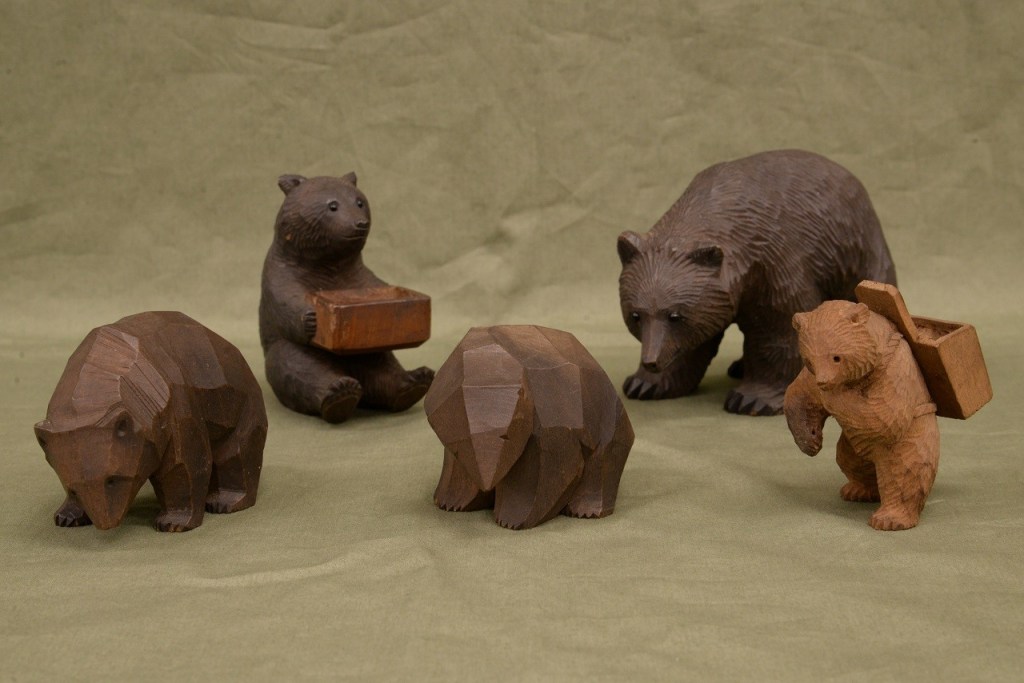
Yakumo Town Wooden carved bears. Image taken from Shigeyuki Otani, Curator, Yakumo Town Local History Museum and Wood Carving Bear Museum’s post.
In writing about helping to ensure the continuation of agricultural communities, Shiomi-san touches upon the difficulties people farming have faced in securing income during the fallow season and the creative endeavours that have come to be born in these periods as a result. Me and Mika also reflected on the importance of having a fallow season and how it can result in creativity rising to the surface using what’s in your environment.
One such example is in the above photo of wooden carved bears known all over Japan as being associated with Hokkaido. A skill and now a culture that was developed by people farming when fields needed to rejuvenate, this fallow period also gave people time to shift to different kinds of activities. Other crafts in other prefectures have been developed as a result of this fallow period as well, like glasses-making in Sabae city in Fukuoka prefecture. If you’re interested in more of these kinds of fallow season farming crafts, we recommend researching Kanae Yamamoto and the Farmer’s art movement.
Something that’s touched upon here is likely something you’ve heard about our current era already; that in shifting to non-agricultural, more sedentary ways of living, we’ve also lost touch with this fallow period of rejuvenation which helps reconnect us to art, craft and making things with our hands together with community members. From this period of stillness, we give space for what we’ve learned to integrate and for old thoughts and ideas to rise to the surface. It also leads to creativity in having a constraint of not being able to do what you usually do and reflecting on what else is there in your environment.
At least this was so for mine and Mika’s experiences of having periods of time with different rhythms, which we recognize comes with an amount of privilege. For Mika, contributing to the retreat centre Yōjōen, in Nagano, not having central heating means the centre is closed for four months in the winter. During this time, Mika returns to her parents and is able to catch up on reading books, go on vipassana retreats, travel and make clothing. For me, it was during a year after I left a corporate role that I had the time to take a course deep diving into how I wanted to live and connected with Mika to initiate this co-translation project.
It’s been a deep learning journey so far that I believe has given me some footing that lead to even more meaningful contribution within a community of practise called NGL. I think for Mika as well, this project is leading to new beginnings. Since starting, she has also started the translation of Satish Kumar’s autobiography No Destination into Japanese. The book writes about his unbelievable pilgrimage journey across the world with no money, accepting only vegan food, with a friend in the name of peace. Satish is co-founder of Schumacher College where Mika completed her MA in Transition Economics.
Book Updates
We’ve sent our first round of feedback to Carolyn on two possible covers for the book and she is working on them as we speak. The sixth person asked to review our draft confirmed after all, and everyone has started adding their comments and suggestions. Me and Mika have the rest of chapter 3 and chapters 4 and 5 remaining to read and translate together. And we’re not meeting our original release of this spring which is fine when you don’t have a deadline but are really aiming to release this by the time I am set to move to Ayabe for the year in the fall as we’ve been holding this project for some time now.
Requests for You, the Reader
If you have any celebrations, appreciations or comments regarding what you read in this post, we’d be intrigued and grateful to receive them to help fuel our journey.
That’s all for now!
Katherina, on behalf of Mika and Shiomi-san as well
 Book Updates and Our Co-Translation Journey
Leave a comment